Category Archives: Jane’s Blog

Organised Sports are not Play….

This article has a strong US focus but contains many thinking points for me. It echoes again how much children’s lives have changed in recent years and how much more adults directed they become. Well meaning adults work as hard as they can (in more ways than one) to do the very best for their children but, by inflicting adult determined rules and goals on children, instead can limit children’s opportunities to learn and develop.

As with most things I think there is a balance to be had. The discipline, teamwork and sportsmanship that comes with organised sports is significant though I’d agree with the article that these are not skills particularly suited to very young children who are still developing emotional, communication and movement skills.

https://www.self-directed.org/tp/organized-sports-not-play/

Learning through Woodwork

Staff at playgroup have observed the children’s significant and sustained interest in tools. Over the last year we have been building on this interest and providing increasing opportunities to use real tools. Children enjoyed hammering golf tees into a pumpkin last Hallowe’en, they’ve helped dismantle the rotten sandpit in the garden using an electric screwdriver. They’ve become very proficient at assembling Ikea wooden boxes and even helped with the finishing touches to our garden water play feature.


Their interest and enjoyment in these projects has been the primary inspiration for building (!) on the use of real tools in the playgroup setting. Pete Moorhouse’s book has been the secondary inspiration. His enthusiasm and guidance has led to us now having our own workbench complete with vise, saw, screwdrivers, pliers and hammers.

Pete’s book is full of useful information highlighting the way that working with real tools encourages children’s independence and fosters creative learning. We have already witnessed deep learning at the woodwork bench. The children’s concentration and focus is substantial and can only benefit their abilities to be creative, to persevere and problem solve let alone provide significant exposure to opportunities to develop coordination, physical skills, language and communication.

Pete’s book is not just for children! It inspired me to get out my tools and create the workbench.

I’ve rebuilt my garden deck over the summer and I’m learning to carve spoons.


It’s given me a “can do” attitude. When I went through secondary school (and it wasn’t that long ago!) girls all did Home Economics and learned to cook and sew. Admittedly I loved this and still enjoy these activities. I regret now though that I was never given the opportunity to do woodwork, that was reserved for the boys. It’s an activity I’m now getting a lot of enjoyment from. It highlights for me again the learning that is in learning and why I love working in Early Years.  I’m learning just as much as the children are.

I have Pete’s book, if you’d like to read it please let me know, I’m happy to lend it out for short periods. He has an on-line booklet  too though, for anyone who is interested. Both the book and booklet are probably more aimed at professionals working with children but are still worth a read to get a flavour of the massive range of benefits woodworking provides.

Jane


Should children be able to read and write by age 4?

Shocked by this article which states there are concerns that children are starting school unable to read or write. And, if that wasn’t bad enough, it clarifies that this is at age 4! Thank goodness I live and work in Scotland where we are a little more in tune with children’s learning and development 🤷🏼‍♀️

https://www.telegraph.co.uk/education/2018/08/08/300000-children-taught-unqualified-nursery-staff-charity-warns/


Preschool Is Crushing Kids?

This article is US based but still very relevant. I love the suggestion that nursery (kindergarten) is now considered a gatekeeper checking who is ready and who is not to go to school when once it was the welcome mat encouraging children to cross into formal schooling.
I have often said that relationships are central to positive early years experiences and its one of the reasons I am so passionate about playgroup. At playgroup we have the advantage of significant parental inviolvement and of being very community focussed – both of which foster relationships between staff, parents and community as well as with children. Its a win win situation as far as I am concerned.
By its very name playgroup centres around children’s play – the way children are designed to learn – not on teaching and not on being the first step of the formal education ladder.
A child’s early years are short and we shouldn’t be wasting them by imposing our adult ideas of what their learning should look like.

https://www.theatlantic.com/magazine/archive/2016/01/the-new-preschool-is-crushing-kids/419139/?utm_source=fbb

Makaton Friendly

I took over the role of lead practitioner at Cambusbarron Playgroup in September last year. Our playgroup is a small, but busy, community playgroup for children aged from 2 1/2 to pre-school. We are located in the beautiful village of Cambusbarron, just outside Stirling. Our staff team is small, 2 staff members, 1 administrator and 1 relief staff member. We have for 16 children attending sessions each day.

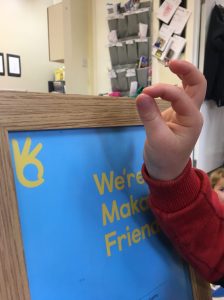
We are very proud to say that our playgroup has just been awarded Makaton Friendly status, the first setting of any kind in the Stirling area to be recognised in this way.

My personal interest in Makaton began many years ago but I only undertook formal Foundation training last year, coincidentally just around when I began working at Cambusbarron.

Last year was also when I completed my honours degree in Childhood Practice. The Makaton rationale and ethos resonated very clearly with what I had studied about children’s learning and development. It seems so obvious that communicating information both orally and visually enhances learning.

Having loved every minute of Foundation I immediately signed up for the Enhancement course which I completed early this year. I have been passionately using and promoting Makaton since.

Although Makaton had been in use before at playgroup it is now much more embedded in our daily routines. Our children love signing and are always keen to show off their skills. We sign our names at Welcome Time and parents, staff and children all learn the Sign of the Week and promote it more widely within our community. Last Christmas we learned how to sign Christmas carols and went carol singing and signing in a local supermarket. We have received very positive feedback from parents and its rewarding to hear reports of children teaching their parents and siblings how to sign.

We have created our own electronic dictionary of the Makaton signs we know. Each sign is shown with the relevant symbol and a video of one of our children demonstrating the sign. The children enthusiastically help find, then copy and paste, images into our dictionary. They love taking videos of each other demonstrating the signs. We have recently asked family and community members to submit videos of them signing too – we aim to include more people in the community and make our dictionary a real village resource. The learning achieved by the children in this project is significant. In addition to the Makaton signs and symbols they are developing communication and language skills. They are learning about technology and developing social and emotional skills such as teamwork, confidence and perseverance.

It has been gratifying to see that parents and staff have also embraced the use of Makaton and a supportive learning community has developed around signing. Just as there is always something new to learn there is also a new sign to learn This week we read the story Shark in the Park and, of course, had to find out how to sign Shark and Park!